

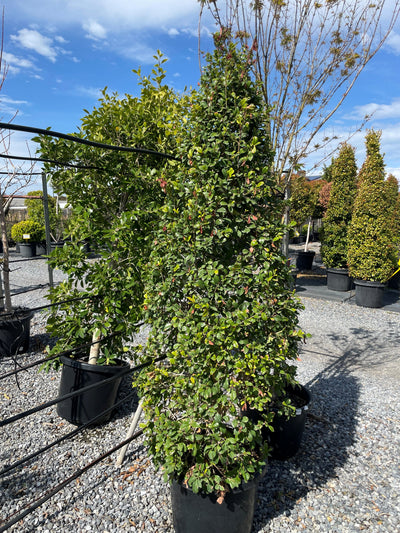
TOPIARY / Syzygium australe 'Up & Away' (Cone)
Plants travel upright in enclosed trucks - not general couriers.Learn more
Or plant one of these instead
This one is available today and does the same job in the garden.
Finish the job
Brush Cherry Cone Topiary — 'Up & Away'
Botanical Name: Syzygium australe 'Up & Away'
Family: Myrtaceae
Origin: Eastern Australia (Queensland & New South Wales rainforest margins)
Plant Type: Evergreen native shrub; presented here as a pre-trained cone topiary
Overview
Syzygium australe 'Up & Away' is a compact, densely branching cultivar of the native Brush Cherry, selected specifically for its tight upright growth and exceptional response to clipping — making it one of the finest choices for formal topiary in South Australian gardens. Pre-trained into a crisp cone form, this specimen arrives ready to make an immediate statement in pots, entryways, or structured garden beds. Its glossy deep-green foliage flushes with vivid copper-pink new growth, providing year-round colour and interest far beyond the purely architectural.
Key Features
- Mature Size: 1.5–2.0 m H x 0.6–0.8 m W (when maintained as a cone topiary; unpruned can reach 3 m H x 1.5 m W)
- Growth Rate: Moderate to fast; 25–40 cm per year in favourable conditions; naturally dense and self-branching, producing a tight canopy that holds its clipped form well between maintenance trims
- Foliage: Glossy, lance-shaped deep green leaves 4–7 cm long; new growth flushes a striking coppery-pink to red, cycling through multiple times per year and providing vivid seasonal contrast against the mature foliage
- Flowers: Fluffy white to cream, brush-like flowers (characteristic Myrtaceae staminate clusters); non-fragrant; appear in summer (December–February), often partially obscured by foliage on clipped specimens but still attractive up close
- Seasonal Interest: Strongest in spring and summer when new copper-pink flushes are most vivid; cream flowers in summer add softness; small red-to-purple edible berries may follow on less-frequently clipped specimens in autumn
- Wildlife Value: Flowers attract bees and beneficial insects; berries (when allowed to form) attract honeyeaters and other native birds; a useful wildlife corridor plant when grown in informal settings
- Tolerance: Moderate drought tolerance once established; tolerates coastal conditions including salt-laden winds; heat-tolerant across Adelaide's hot summers; tolerates light frost to approximately −2 °C (protect young plants in Adelaide Hills frost pockets); clay-tolerant in well-structured soils; wind-tolerant once established
- Planting Density: Formal cone pair (entryway): one specimen each side, 80–100 cm from path centreline; formal avenue or repeated cone accent: space individual cones 1.2–1.5 m apart centre-to-centre (approx. 0.7–0.8 plants per metre) for a structured repeated rhythm without crowding the cone silhouette
- Pet Friendly: Syzygium australe is not listed as toxic to dogs or cats by major veterinary authorities; however, the berries, if consumed in large quantities, may cause mild gastrointestinal upset in pets. Keep curious pets away from fallen fruit and monitor accordingly. Consult your vet if ingestion of plant material is a concern for your specific animal.
Where It Works Best
- Sunlight: Full sun to part shade; best cone density and copper flush colour in full sun (6+ hours direct); tolerates half-day shade but may produce slightly looser growth requiring more frequent clipping
- Soil: Adaptable to a wide range of soils including loam, sandy loam, and moderately heavy clay; prefers well-drained to moisture-retentive soils enriched with organic matter; in pots, use a premium native or general-purpose potting mix with added perlite for drainage
- Water Needs: Establishment (first 12–16 weeks): water deeply every 2–3 days in warm weather (every 4–5 days in cooler months) until root system is well anchored. Established: summer — deep water 1–2 times per week during heatwaves and dry spells (December–March); winter — reduce to once every 10–14 days or rely on natural rainfall in Adelaide's wet season; potted specimens require more frequent watering year-round, checking soil moisture before each application
- Maintenance: Clip 2–3 times per year to maintain the cone silhouette — ideally after each major new growth flush (typically late spring, mid-summer, and early autumn). Use sharp hedging shears or electric trimmers. Apply a slow-release native fertiliser (low phosphorus) in spring to support vigorous, healthy regrowth. Mulch base to 7–10 cm depth, keeping mulch clear of the trunk.
- Lifespan: 20–40+ years with appropriate maintenance; the topiary form is indefinitely renewable through regular clipping
- Climate Zones: Ideally suited to Adelaide's temperate Mediterranean climate (metro, inner Hills fringe, and coastal zones); performs excellently in coastal suburbs (Glenelg to Aldinga); reliable in the Adelaide Plains and foothills; suitable for warmer Barossa and Riverland regions with adequate summer watering; use caution in deep Hills frost pockets below −3 °C without protection
- Soil pH: Mildly acid to neutral preferred; pH 5.5–7.0; tolerates slightly alkaline soils (to pH 7.5) with the addition of soil acidifier and iron chelate to prevent chlorosis
Landscape & Design Ideas
- Position a matched pair flanking a front entry, driveway gate, or garden doorway in large glazed pots for a classic formal statement that suits both contemporary and traditional South Australian architecture
- Plant a repeated series of cone topiaries along a path or low fence line, spaced 1.2–1.5 m apart centre-to-centre, to create a rhythmic formal avenue that defines space without blocking light or views
- Use as a bold vertical accent within a mixed native garden bed, contrasting the precise cone geometry against the soft texture of ornamental grasses, lomandras, or prostrate grevilleas for a modern Australian garden aesthetic
Why You Will Love It
'Up & Away' delivers everything a formal topiary should — crisp architectural form, year-round glossy evergreen foliage, and that unmistakeable flush of coppery-pink new growth that reminds you this is very much a living, breathing native plant, not a static green sculpture. Hardy enough for Adelaide's punishing summers, adaptable to pots or garden beds, and already pre-trained to save you years of shaping work, this cone topiary is the ultimate low-effort, high-impact investment for any garden that takes its kerb appeal seriously.