
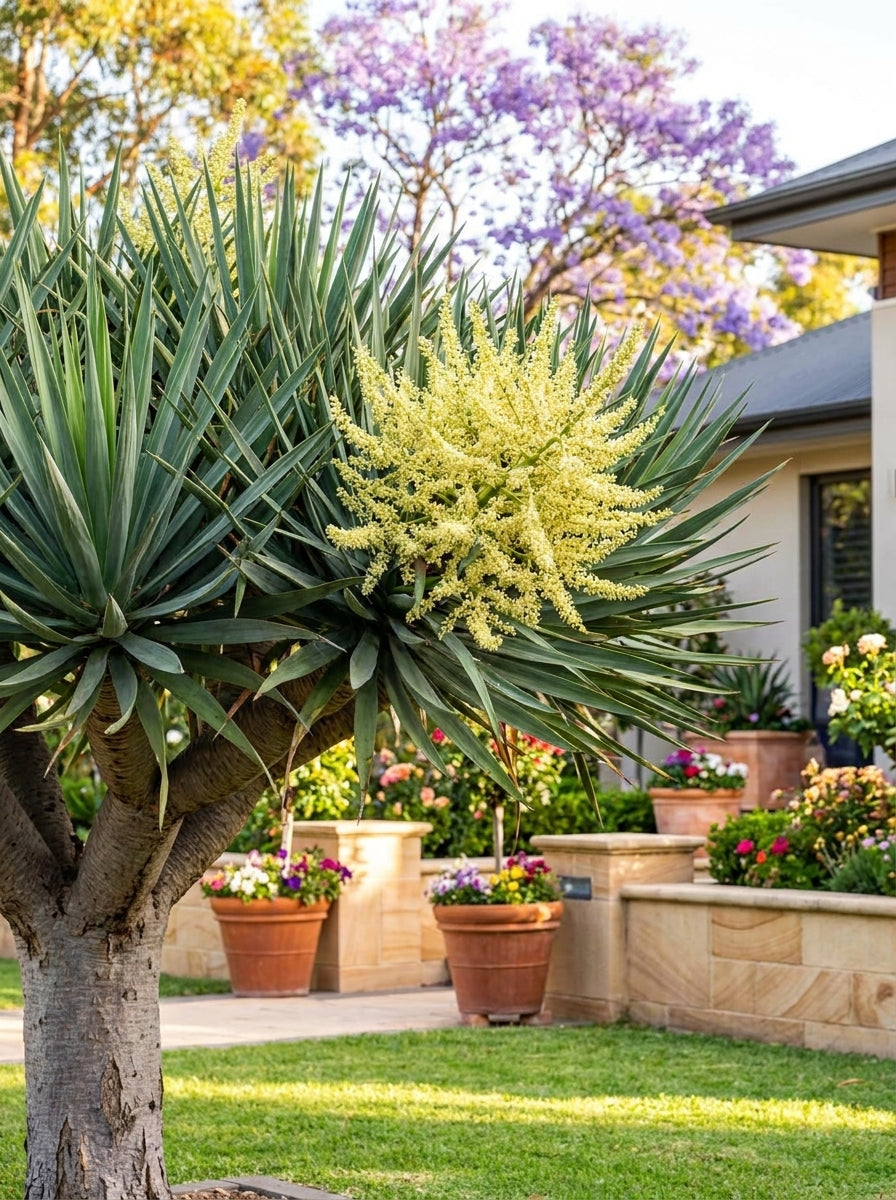


Dracaena draco
Plants travel upright in enclosed trucks - not general couriers.Learn more
Finish the job
Dragon's Blood Tree
Botanical Name: Dracaena draco
Family: Asparagaceae
Origin: Canary Islands, Madeira and Cape Verde (rocky, arid coastal landscapes)
Plant Type: Evergreen tree / architectural feature plant
Overview
One of the most extraordinary and ancient-looking trees in the plant world, Dracaena draco is a plant of genuine mythology and spectacle. Its common name comes from the deep red resin — called dragon's blood — that oozes from the bark and stems when cut, a characteristic so remarkable that ancient cultures used it in medicine, dye and varnish for centuries. The tree itself is equally extraordinary: a slow-growing, supremely architectural evergreen that develops over decades from a single-stemmed rosette into a dramatic umbrella-shaped canopy of stout branches, each terminating in a dense rosette of long, stiff, blue-green sword-shaped leaves.
An RHS Award of Garden Merit recipient, Dracaena draco is perfectly suited to Adelaide's warm, dry Mediterranean climate. It thrives in full sun, tolerates drought, coastal salt winds and poor soils with complete ease, and is simply one of the most impressive long-term garden investment plants available. Exceptionally long-lived — some wild specimens are estimated to be several hundred to over a thousand years old — this is a tree that will outlast the garden and everyone in it. Buy the largest specimen you can afford and let time do the rest.
Key Features
- Mature Size: 4–8 m H x 3–5 m W in Adelaide garden conditions over many decades; develops a dramatic flat-topped umbrella canopy with age; young plants are single-stemmed rosettes for many years before branching begins
- Growth Rate: Very slow; approximately 5–10 cm per year in early years, somewhat faster once established in warm conditions; branching begins only after first flowering, which may take 10–15+ years; buy advanced stock for the best impact
- Foliage: Long, stiff, sword-shaped blue-green to grey-green succulent leaves arranged in dense terminal rosettes at branch tips; each leaf 40–60 cm long; leaves shed slowly from the base as the plant grows, revealing clean, ringed stems; evergreen year-round; red resinous sap ("dragon's blood") exudes from any wound to the bark or stems
- Flowers: Spectacular large terminal spikes of fragrant creamy-white to greenish-white flowers on mature specimens; produced irregularly — flowering triggers the first branching of the trunk, which is a landmark event in the plant's development; followed by round, fleshy orange-red fruits attractive to birds
- Fragrance: Flowers fragrant; foliage not fragrant
- Seasonal Interest: Bold architectural blue-green rosette form year-round; extraordinary umbrella canopy develops over many years; rare and spectacular flowering spikes on mature specimens trigger trunk branching; orange-red fruits follow flowering; the plant becomes more architecturally magnificent with every passing decade
- Wildlife Value: Fragrant flowers attract bees and beneficial insects; orange-red fruits attract fruit-eating birds; branching canopy provides perching and shelter
- Tolerance: Excellent drought tolerance once established; excellent heat tolerance; outstanding coastal and frontline salt spray tolerance; wind-tolerant; frost-sensitive — protect from frost, especially when young; tolerates poor, sandy, rocky and low-fertility soils; dislikes waterlogging; dislikes humid tropical climates
- Planting Density: Single feature specimen with 3–4 m clearance to allow full canopy development; groups of 3 at 2.5–3.0 m spacing for a dramatic grove; excellent in large containers (50 cm+) for many years
- Pet Friendly: Toxic to cats and dogs if ingested — keep away from pets
Where It Works Best
- Sunlight: Full sun; essential for best growth, most compact rosette form and overall plant health; tolerates bright indirect light in containers; light afternoon shade protection in Adelaide's hottest inland positions may benefit young plants
- Soil: Free-draining sandy, loamy or gravelly soils; excellent drainage is non-negotiable — will not tolerate wet feet or waterlogging; tolerates poor, rocky and low-fertility soils; avoid heavy clay without significant improvement
- Water Needs: Establishment: water well every 1–2 weeks for first 6–12 months. Established: very low; deep soak every 3–4 weeks in summer; little to no watering in cooler months; one of the most drought-adapted specimen trees available for Adelaide
- Maintenance: Virtually maintenance-free; remove spent flower spikes and dead lower leaves as needed; do not prune the growing tips or terminal rosettes; feed sparingly with a slow-release fertiliser in spring; apply coarse gravel mulch around the base; the tree essentially looks after itself once established
- Lifespan: Exceptionally long-lived; centuries in ideal conditions; this is a generational garden investment
- Climate Zones: Near-perfect match for Adelaide's Mediterranean climate; performs excellently across Adelaide Plains, coastal suburbs, Fleurieu Peninsula and Yorke Peninsula; protect young plants from frost in cooler foothills positions; one of the most climate-suited exotic specimen trees for SA
- Soil pH: Slightly acidic to neutral preferred; tolerates mildly alkaline conditions with good drainage
Landscape & Design Ideas
- Iconic long-term feature specimen for large gardens, commercial landscapes and public spaces where its extraordinary architectural development over decades creates an ever-more-impressive focal point
- Frontline coastal garden specimen where outstanding salt spray, wind and drought tolerance make it one of the most reliable large feature plants for exposed SA coastal positions
- Contemporary, Mediterranean and arid-style garden centrepiece paired with Agave, Aloe, ornamental grasses and gravel mulch for a bold, low-water sculptural composition
- Large container specimen for sheltered courtyards, rooftop gardens and commercial entrances where the bold rosette form delivers instant architectural drama at any age
- Avenue or grove planting in groups of 3 or 5 for commercial landscapes and large residential gardens where the developing umbrella canopies will create a genuinely unforgettable long-term display
Why You Will Love It
Dracaena draco is not a plant for the impatient — but it is absolutely a plant for anyone who thinks in decades and wants a garden feature that will only get more extraordinary with time. The blue-green rosette form is striking from day one, the coastal and drought toughness is outstanding, and the slow, magnificent development of the umbrella canopy over the years is one of gardening's great long-game rewards. Buy advanced stock, plant it in full sun with perfect drainage, and let it become the centrepiece your Adelaide garden deserves.